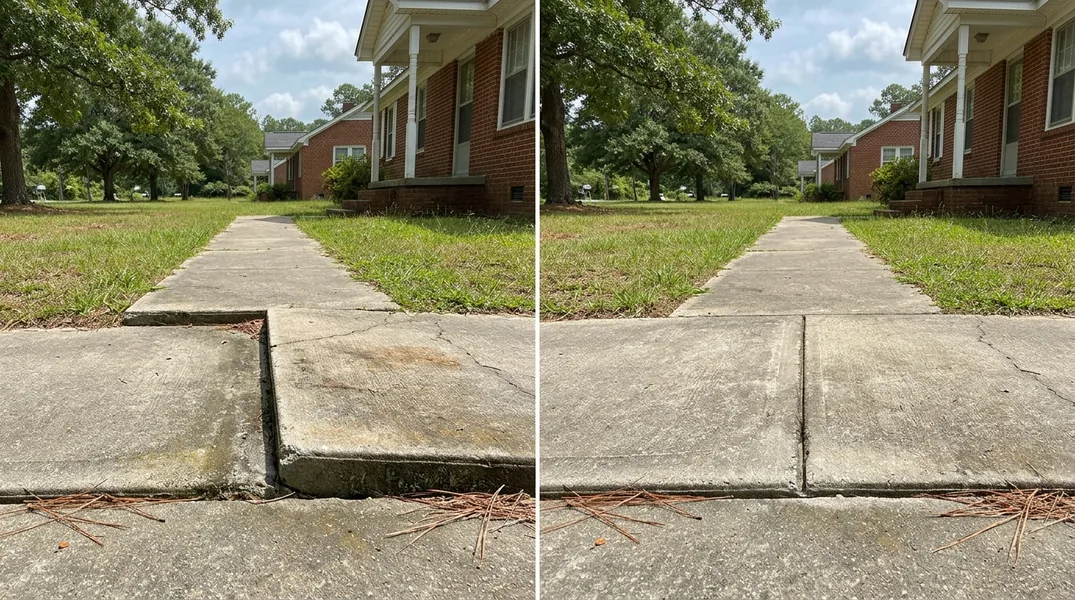
The Sandhills Challenge: Understanding Fayetteville's Unique Soil Composition
Fayetteville sits in the heart of North Carolina's Sandhills region, a geological area defined by sandy, unstable subsoil that presents unique challenges for concrete construction. Unlike areas built on clay or bedrock, the Sandhills feature a composition of fine sand, silt, and clay layers that shift and settle over time. This combination creates an unpredictable foundation for any concrete project, from Concrete Driveways to patios and walkways.
When contractors pour concrete in Fayetteville, they're working against geology itself. The sandy soil beneath the surface lacks the stability of more compacted earth. Water drainage through sand is rapid, which means moisture moves quickly through the subsoil layers. This constant movement of water and the natural settling of sand particles create a foundation that is anything but static. Over months and years, this movement translates directly into stress on your concrete surface, leading to the cracks, settling, and deterioration that so many homeowners in the area experience.
Sandy Soil Concrete Settling in Fayetteville, NC: How It Happens
Sandy soil concrete settling is one of the most common problems we address at Fayetteville Concrete. The process begins immediately after your concrete is poured. While the concrete cures and hardens, the sand and soil beneath it continues to compact and shift. Fine sand particles, which make up much of the Sandhills subsoil, are particularly prone to settlement because they lack the cohesion of heavier clay or the permanence of rock. Every rainfall, every freeze-thaw cycle, and every year of weathering causes additional compaction and movement in the layers below your slab.
The problem accelerates when water becomes involved. Rain and groundwater percolate through the sandy layers, carrying fine particles downward in a process called piping. This creates voids and weak spots beneath your concrete. A driveway that seemed perfectly solid one year may develop noticeable dips and cracks the next. The settlement is rarely uniform, which is why you often see one section of a driveway sink while another remains level. This differential settling puts immense stress on the concrete itself, causing the characteristic cracking patterns that homeowners in Fayetteville know all too well.
Washed Out Sand Under Slab: The Hidden Threat Beneath Your Feet
One of the most insidious problems in the Sandhills is washed out sand under slab. This occurs when water moves through the sandy subsoil and removes fine sand particles, leaving behind hollow spaces directly beneath your concrete. These voids are invisible from above until the concrete finally fails. A driveway or patio may feel solid one day, but the support structure underneath is being eroded away by water movement. Over time, the concrete loses its foundation and begins to sink into these voids, creating the hollow sound you hear when you walk or drive over certain sections.
Washed out sand under slab is particularly problematic because homeowners rarely realize it's happening until significant damage has already occurred. By the time you notice cracking or settling, the void space beneath may be several inches deep. This is why preventative measures and professional installation are so critical in Fayetteville. Proper base preparation, adequate drainage design, and the use of stabilized subgrades can significantly reduce the risk of this type of failure. When problems do develop, professional Concrete Repair & Resurfacing is often necessary to restore safety and function.
Clay Subsoil Slab Cracking: When the Lower Layers Fail
Beneath the sandy surface layers in many parts of Fayetteville, you'll find clay subsoil that presents its own set of challenges. While clay is more stable than sand in some ways, it creates different problems for concrete. Clay is highly reactive to moisture. When it absorbs water, it expands. When it dries, it shrinks. This constant expansion and contraction creates movement in the soil layers, which translates into stress on the concrete slab above.
Clay subsoil slab cracking often follows predictable patterns. You may see long, linear cracks running across your driveway or patio, or a network of smaller cracks that resemble a spider web. These patterns indicate that the clay beneath is moving. In dry seasons, clay shrinks and pulls away from the concrete, creating gaps and stress points. During wet periods, the clay swells and pushes upward, causing heaving and buckling. The freeze-thaw cycles common in North Carolina winters make this problem worse. Water trapped in clay freezes, expands, and then thaws, repeating the cycle and gradually weakening the bond between the soil and your concrete slab.
Concrete Repair in Fayetteville, North Carolina: Addressing Soil-Related Damage
When your concrete shows signs of settling or cracking due to soil problems, timely Concrete Repair & Resurfacing can prevent small issues from becoming catastrophic failures. The key is understanding the root cause. Simply filling a crack or patching a sunken section without addressing the underlying soil problem is a temporary fix that will fail again. At Fayetteville Concrete, we diagnose the specific soil and drainage issues causing your damage, then recommend solutions that actually work.
For minor cracking and settling, mudjacking or concrete lifting can restore a level surface without removing and replacing the entire slab. These techniques work by injecting stabilizing material beneath the concrete to fill voids and support the slab. For more severe damage, or when the subsoil has been compromised beyond repair, replacement with a properly engineered base may be necessary. The investment in proper repair now protects your property from further damage and extends the life of your concrete. If you're noticing signs of settling or cracking, contact Fayetteville Concrete at (910) 672-6909 for a professional evaluation and free estimate.
Prevention and Best Practices: Building Concrete Right in the Sandhills
The best approach to dealing with Fayetteville's challenging soil conditions is prevention. When new concrete is installed, proper site preparation and base construction are essential. The subgrade must be adequately compacted and, in many cases, stabilized with gravel or recycled asphalt to provide a more stable foundation than raw sand or clay. Drainage must be carefully planned to direct water away from the concrete and prevent water from pooling or moving through the subsoil in ways that cause erosion and settlement.
For homeowners planning new Concrete Driveways, Concrete Patios, or other concrete projects in Fayetteville, choosing a contractor who understands local soil conditions is critical. Experienced contractors know how to design for the Sandhills. They use thicker base materials, incorporate proper slope for drainage, and sometimes recommend reinforcement options that add durability. The upfront investment in quality installation and site preparation pays dividends in years of trouble-free use. If you're planning a concrete project or need to repair existing concrete, we encourage you to reach out for a free estimate and professional guidance tailored to your property's specific soil and drainage conditions.
Looking for a professional concrete contractor in Fayetteville? Fayetteville Concrete responds fast for all your concrete needs.
Get a Free QuoteOur services: Concrete Driveways · Concrete Patios · Stamped & Decorative Concrete